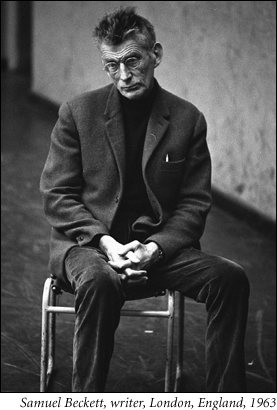
Thursday, November 15, 2012

Fizzle Me This, Batman

Beckett certainly has an interesting style in which he writes and expresses himself, and "Fizzles" helped in developing a better understanding for Beckett's works. The story is split into eight different proses with the first/last describing the beginning/end of any Beckett work, and the material in-between have influences from a large variety of Beckett classics. It was quite interesting how Beckett worked in different materials to make a seemingly new story. My favorite from these eight selections was '7' since it used the writing style of "Imagination Dead Imagine" and the character/setting/mood of "Endgame." Beckett basically retold both of these stories, yet taking it from a different perspective allowed for new themes/thoughts to emerge from these stories. I feel the ultimate message Beckett addresses to the reader is how the creative process is never over and a written work is always open to editing thus allowing for something  new or different. I also believe he is addressing archetypes/themes used by authors in a multitude of their writings such as reoccurring symbols in the Beckett universe like the bicycle.

Here's a small excerpt from a work I previously wrote, "Marxist Kids with Iphones," which was inspired by the writing style and thought of Samuel Barclay Beckett: Nightmares full of comma splices and misguided development, or rather development does not exist in this dreary plane, for it is unnecessary in the development of relationships, so then no development in this existence of void creates development in our own void of existence and non-existence, misguided grammar and form, crafting a plane where there is no room to take off, ready to fly, ready to fall, always flying, always falling, and for what you may ask, but I will not answer, for answers are not my thing, nor do I care much lending personal bias into the lives of others, so I give them a minimal portion of a story, situation, celebration, mourning, discovery, circumstance, or what have you, and I expect THEM to craft it themselves, for I hope you all are open to experimentation of many kinds, and I promise you gentlemen that last statement was not homosexual by any standards, good night, sleep tight, and come again, oh please, keep on coming, going and coming, sleeping and running, dying and running, coming and going.

Wednesday, November 14, 2012

Sappy Days, Indeed Friends

Happy Days is a sappy play, it is not sappy, it is not a play, there is no Fonzie, the show must go on, it can’t go on, the show will go on. The other three Beckett plays we've reviewed in lecture promoted self-reflection alongside a dreary disposition in the characters, yet none of them compare to Winnie’s complete hopelessness she experiences in a distorted marriage; Although, Beckett is able to capture his strongest bond between two ‘real’ people without evoking empty language, and instead turns to stage directions and pausing to convey an undying loyalty incomprehensible to common sense or elementary reasoning.
Most of the play revolves around this mature/elderly woman who has seemingly lost her mind from a meaningless marriage. Winnie & Willie are just your typical couple featuring the overly sentimental housewife who doesn't get out much and the lame husband busily keeping up to date with current affairs, yet such a multitude of broad headlines causes many of this information to be practically useless in expanding Willie’s mind. Both characters have nothing to say, but they also have a great deal to discuss. What exactly does our mind wonder about when it is not being occupied? Perhaps we are afraid of this real our mind contains, or even try consciously and unconsciously to repress some memory. Winnie engulfs her mind’s vortex with the glories of materialistic consumerism since her single purse contains all these vague items. Materials that mask the war we communicate with other and how others communicate with us (The most notable example being cosmetics enhancing beauty). Willie reads the new, but how can he trust something created by biased creators? We can question these tangible items, yet they may begin to question that we wish not to address. These distractions guide us, Winnie, Willie, Beckett, humans in general because stimulation of our minds’ desires assist us in ignoring that one essential question: why the hell are we are?
I feel Beckett answers this question stupendously well at the play’s ‘conclusion.’ There are small murmurs of exchange between Winnie & Willie, but their movement and reactions trigger a strong emotional chord in the reader. I did not arrive to this assumption in my first reading and discovered this powerful exchange in the film version. Beckett’s precise location of pauses and petite facial expressions allow the reader a viewing of “Happy Days” that had and do exist in Winnie & Willie’s relationship. They do not understand one another, but I will take the risk in asserting this is a result of humans being incapable of fully understanding loved ones no matter how well one may know another. These characters speak, but language does not help them understand one another. In silence and observation, the reader and the characters can see a realistic romance for all its worth in its glory and disparity. This play is not a direct to DVD Disney fantasy while being that perfectly idealistic fairy tale in a form relevant to us and attainable for all who seek it. 


Sunday, November 4, 2012

What the Krapp is Going on Here!!?

At first glance of this play, I thought this would be a rather elementary reading since it was merely short of ten pages. I knew it would be a challenge nonetheless from being a Beckett work, but I was sure it being so short meant I could read it a few times and get something out of it within an hour. Obviously, I was wrong about this assertion and it took me ages to finally get something out of this rather confusing play.

Actually seeing the play on film helped me in understanding the stage directions at parts I got lost, but I still was not able to make anything out of the play. I read through it multiple times and tried defining some kind of meaning in select sections, yet I was still at a failure in comprehension. There were some parts like the fire that I got an idea that it might stand for something like the passion involved with writing; although, I was not able to find a way to paint a bigger picture out of this thought. I also noticed quite a bit of religious imagery that I wasn't able to understand its implications such as the duality between light/dark and the idea of the fire acting as the holy ghost (something I recall from a Bible story regarding the holy spirit coming down in tongues of fire which helped the disciples understand language universally). What really helped me in putting these thoughts together was searching up the inspiration of "Krapp's Last Tape" with Ethan at the beginning of class last Wednesday. We discovered that the play was inspired from Beckett listening to Patrick Magee reading excerpts from Molloy.

This understanding greatly helped in figuring the content of the play since I saw more validity in my ideas like the fire standing for writing's passion. The tapes were in a way a metaphor for writing with the older author looking upon the works he did when he was in his thirties, and then the comparison from that to the writings from his twenties. This would all make sense in regards to how authors change their style over time and especially how we have seen that in Beckett. We started the semester looking at the older Beckett and then shifted back to his earlier works which were dramatically different in composition. I don't think he is discrediting his older works in anyway, but certainly Beckett is saying that our writing/ideas/beliefs do change and can even do so in a sense completely contradictory to former ideologies.

I think my favorite element of this play involves the style being strikingly similar to that of the original trilogy with a central character explaining these stories through the lenses of non-present characters. Beckett made Molloy theatrical through incorporating stage movement and dialogue between three different periods of a person's life thus adding a new dimension for storytelling.