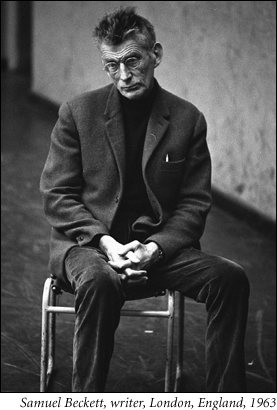
Thursday, November 15, 2012

Fizzle Me This, Batman

Beckett certainly has an interesting style in which he writes and expresses himself, and "Fizzles" helped in developing a better understanding for Beckett's works. The story is split into eight different proses with the first/last describing the beginning/end of any Beckett work, and the material in-between have influences from a large variety of Beckett classics. It was quite interesting how Beckett worked in different materials to make a seemingly new story. My favorite from these eight selections was '7' since it used the writing style of "Imagination Dead Imagine" and the character/setting/mood of "Endgame." Beckett basically retold both of these stories, yet taking it from a different perspective allowed for new themes/thoughts to emerge from these stories. I feel the ultimate message Beckett addresses to the reader is how the creative process is never over and a written work is always open to editing thus allowing for something  new or different. I also believe he is addressing archetypes/themes used by authors in a multitude of their writings such as reoccurring symbols in the Beckett universe like the bicycle.

Here's a small excerpt from a work I previously wrote, "Marxist Kids with Iphones," which was inspired by the writing style and thought of Samuel Barclay Beckett: Nightmares full of comma splices and misguided development, or rather development does not exist in this dreary plane, for it is unnecessary in the development of relationships, so then no development in this existence of void creates development in our own void of existence and non-existence, misguided grammar and form, crafting a plane where there is no room to take off, ready to fly, ready to fall, always flying, always falling, and for what you may ask, but I will not answer, for answers are not my thing, nor do I care much lending personal bias into the lives of others, so I give them a minimal portion of a story, situation, celebration, mourning, discovery, circumstance, or what have you, and I expect THEM to craft it themselves, for I hope you all are open to experimentation of many kinds, and I promise you gentlemen that last statement was not homosexual by any standards, good night, sleep tight, and come again, oh please, keep on coming, going and coming, sleeping and running, dying and running, coming and going.

Wednesday, November 14, 2012

Sappy Days, Indeed Friends

Happy Days is a sappy play, it is not sappy, it is not a play, there is no Fonzie, the show must go on, it can’t go on, the show will go on. The other three Beckett plays we've reviewed in lecture promoted self-reflection alongside a dreary disposition in the characters, yet none of them compare to Winnie’s complete hopelessness she experiences in a distorted marriage; Although, Beckett is able to capture his strongest bond between two ‘real’ people without evoking empty language, and instead turns to stage directions and pausing to convey an undying loyalty incomprehensible to common sense or elementary reasoning.
Most of the play revolves around this mature/elderly woman who has seemingly lost her mind from a meaningless marriage. Winnie & Willie are just your typical couple featuring the overly sentimental housewife who doesn't get out much and the lame husband busily keeping up to date with current affairs, yet such a multitude of broad headlines causes many of this information to be practically useless in expanding Willie’s mind. Both characters have nothing to say, but they also have a great deal to discuss. What exactly does our mind wonder about when it is not being occupied? Perhaps we are afraid of this real our mind contains, or even try consciously and unconsciously to repress some memory. Winnie engulfs her mind’s vortex with the glories of materialistic consumerism since her single purse contains all these vague items. Materials that mask the war we communicate with other and how others communicate with us (The most notable example being cosmetics enhancing beauty). Willie reads the new, but how can he trust something created by biased creators? We can question these tangible items, yet they may begin to question that we wish not to address. These distractions guide us, Winnie, Willie, Beckett, humans in general because stimulation of our minds’ desires assist us in ignoring that one essential question: why the hell are we are?
I feel Beckett answers this question stupendously well at the play’s ‘conclusion.’ There are small murmurs of exchange between Winnie & Willie, but their movement and reactions trigger a strong emotional chord in the reader. I did not arrive to this assumption in my first reading and discovered this powerful exchange in the film version. Beckett’s precise location of pauses and petite facial expressions allow the reader a viewing of “Happy Days” that had and do exist in Winnie & Willie’s relationship. They do not understand one another, but I will take the risk in asserting this is a result of humans being incapable of fully understanding loved ones no matter how well one may know another. These characters speak, but language does not help them understand one another. In silence and observation, the reader and the characters can see a realistic romance for all its worth in its glory and disparity. This play is not a direct to DVD Disney fantasy while being that perfectly idealistic fairy tale in a form relevant to us and attainable for all who seek it. 


Sunday, November 4, 2012

What the Krapp is Going on Here!!?

At first glance of this play, I thought this would be a rather elementary reading since it was merely short of ten pages. I knew it would be a challenge nonetheless from being a Beckett work, but I was sure it being so short meant I could read it a few times and get something out of it within an hour. Obviously, I was wrong about this assertion and it took me ages to finally get something out of this rather confusing play.

Actually seeing the play on film helped me in understanding the stage directions at parts I got lost, but I still was not able to make anything out of the play. I read through it multiple times and tried defining some kind of meaning in select sections, yet I was still at a failure in comprehension. There were some parts like the fire that I got an idea that it might stand for something like the passion involved with writing; although, I was not able to find a way to paint a bigger picture out of this thought. I also noticed quite a bit of religious imagery that I wasn't able to understand its implications such as the duality between light/dark and the idea of the fire acting as the holy ghost (something I recall from a Bible story regarding the holy spirit coming down in tongues of fire which helped the disciples understand language universally). What really helped me in putting these thoughts together was searching up the inspiration of "Krapp's Last Tape" with Ethan at the beginning of class last Wednesday. We discovered that the play was inspired from Beckett listening to Patrick Magee reading excerpts from Molloy.

This understanding greatly helped in figuring the content of the play since I saw more validity in my ideas like the fire standing for writing's passion. The tapes were in a way a metaphor for writing with the older author looking upon the works he did when he was in his thirties, and then the comparison from that to the writings from his twenties. This would all make sense in regards to how authors change their style over time and especially how we have seen that in Beckett. We started the semester looking at the older Beckett and then shifted back to his earlier works which were dramatically different in composition. I don't think he is discrediting his older works in anyway, but certainly Beckett is saying that our writing/ideas/beliefs do change and can even do so in a sense completely contradictory to former ideologies.

I think my favorite element of this play involves the style being strikingly similar to that of the original trilogy with a central character explaining these stories through the lenses of non-present characters. Beckett made Molloy theatrical through incorporating stage movement and dialogue between three different periods of a person's life thus adding a new dimension for storytelling.

Monday, October 22, 2012

Is it not time for my pain-killer? - Humour & Relationships in Beckett's theatrical world

Beckett surely has a way to address his humour, and his theatrical works are no exception to this rule. In my last post I focused on how human despair plays a very crucial role in the comedy of Beckett, and Endgame most certainly delivers that same kind of cynicism. One can see these characters are in a state of disparity through looking at the symbol of the bicycle which has become a motif for happiness in many of Beckett’s works. Clov and Hamm both bring up a point that either of them would had liked a bicycle, but those days have surely passed.


As I discussed in my previous post, a lot of Beckett's humour comes from nonsensical means which is normally an exaggeration of events. This is no different in the case of Endgame, yet Beckett presents it differently through conversation between characters that appears more realistic than in Waiting for Godot. I say this because each of these characters have a sense of identity where before it seemed they were just displacements of a central character. I propose there is actually a development in the characters (character development in a Beckett work!???) which contributes to the humour from how flawed these folks are even at their best. 

Aside from the comedy Beckett explores terrifically, I found the relationship between Ham and Clov to be outstanding (A relationship amongst characters? Did Beckett really write this?). It is quite absurd Clov sticks around no matter how shitty Hamm may treat him, but there is a certain kind of love they share for each other that words cannot describe. They both act like they owe the other for whatever reason, yet it seems there isn't any particular reason they feel this debt of companionship. I believe the reason I thought this was so moving comes from some personal relationships I have had with friends throughout the years. There have been time I have wondered why I am mates with a person and why I help them with their problems, but I normally am not able to yield an answer. Sometimes this causes me to block a person out of my life since I see no reason for union to continue; although, many times I continue to befriend someone because something I can't explain attracts me to her/him. This is similar to the way I see my family since many of them are radically different than myself and it is hard many times to find any common ground, yet I know there exists a meaningful, loving relationship with these family members despite a lack of understanding.

I cannot speak for Beckett, but this relationship makes me feel that these seemingly meaningless relationships have a lot more depth than I would care to believe. It isn't just about opposite attracts or hearing both sides of the story. I think I find myself in these situations because some trait in that person makes me feel good and hopefully it is likewise for that person thus why they are still there after my bullshit.

So is there happiness in this play without the bicycle and underneath the cynical humour? Absolutely! The larger picture I propose Beckett is painting in this play is happiness does not come as an easy handout, and we must search for it in places we feel is tainted by despair, alienation and fear.


Sunday, October 21, 2012

Humour in the Unnameable - Paper Topic


I have spent the past week or so trying to figure out how I will be dissecting “The Unnamable” in order to find the humour Beckett placed throughout. I am not completely sure what direction I want to take this paper in, but I have been reading Freud’s interpretation of humour since Beckett was largely influenced by him.

 In Freud’s “Jokes and their Relation to the Unconscious,” he looks at how nonsense is used to convey humour. Freud believes this is executed through forms of parody, exaggeration, caricature and travesty. Before I found more humour in the stupidity of the characters, but stupidity means thinking too little whereas nonsense is thinking too much. The jar in the head is humourous through his exaggeration of the story progressing around him/her. I greatly enjoy this style of humour since it comes from human reasoning/comprehension.  Everyone has had a rough day and looked back upon it later finding the circumstances funny. One might think there could be no humour in such a tragic setting, but don’t we find ourselves laughing when someone walks into a screen door? Comedy most certainly exists in human pain especially when it is a pain we have experiences before and have come to terms with. 

I wanted to write this paper because I found “The Unnamable” to be funny, yet I was unaware how it invoked my funny bone. I have reread the novel again and wish to read it one or two more times since there were plenty of things I overlooked in my first reading and surely the second as well. I want my next reading to be done once I look more into Freud and other theories regarding how we perceive humour.  I do want a good portion of my paper to be looking at “The Unnamable” from a Freudian perspective, but I also wish to see how irony and other forms of humour are incorporated in the novel. I have just begun reading Jennifer Jeffer’s “Beyond Irony: The Unnamable’s Appropriations of its Critics in a Humorous Reading of the Text” which looks at the novel’s irony through a Romantic and Humanist viewpoint. 


Sunday, October 14, 2012

Memory, Language, Godot – The Importance of Perception


         There are only two acts in While Waiting for Godot spanning over the course of two days, yet the characters (except Vladamir mostly) find a way to erase the previous day’s events including their perceptions of themselves. It seems rather odd that Pozzo does not remember he saw the day prior, but the reader should not be positive of this claim. Stage directions and the other characters’ perception of Pozzo draws a conclusion in the first act that Pozzo could see. An audience member easily presumes Lucky’s rather long tangent seems to mark some intelligence, yet he appears void of language in the second act. Are these mere coincidences between scenes or is the appearance of these characters manipulated by some source?


          It would seem obvious to the reader half way through act 2 that all the characters are insane with Vladamir having some exception; However, Beckett has taught me never trust the sanity and instead question any sliver of rationality. The other characters are imperfect in their memory and actions, yet this over exaggeration seems too surreal to be factual. Vladamir comes across as the only character self aware of the environment around him. I feel the problem with this perception is that Vladamir resembles stability in a universe distorted by Vladamir’s unconscious. Vladamir knows the whole time the two men must be waiting for Godot; although, at no point does he know why they are waiting for Godot thus rising questions to the validity of Vladamir’s decision-making. Only two days pass in the course of the play, but how long have these men been waiting for Godot? I think Vladamir has been waiting for Godot for quite some time within his mind’s void.


          This play was a refreshing ‘simple’ read since the dialogue exchange between characters led to an illusion of interpersonal conversation. I  failed to notice a lot of the deeper material in my first two reads of Godot, but I hope in this next week I can get a better understanding on parts that confused me such as Lucky’s monologue. I would also like to look deeper into this understanding of reality depicted by a single character through the other characters.

Sunday, September 30, 2012

Why Label? Why Characterize?

In Beckett's trilogy, the reader has discovered that one cannot always trust the claims made by the narrator/speaker. It was not until reading “The Unnamable” that I discovered that the stories told by the speakers came about as a way for the main characters to escape their depressing, tedious lives. “The Unnamable” was much clearer with the insanity of the narrator with his/her wide association with Beckett’s other crazy characters. In this regard, this narrator has proved that all of these nonlinear stories told by these wacky speakers are really just a way for a person to figure out and deal with the issues in his/her life.
Beckett has brought up in multiple works the importance of language and comprehension, yet he takes this a step further in “The Unnamable” thorough his excessive use of labeling. Certainly, some underlying worth exists in these labels and symbols, but ultimately I feel that the labeling of Beckett can be so difficult to understand since there exists no purpose in many instances. Beckett intends to show the reader how we tend to think some sort of label must be in the literature in order for appreciation. The unnamed head continues to label all of these things developing in his/her life, but this character strives for the grey area between despair and prosperity.
It is true that there are no symbols where none intended, but some reoccurring symbols/labels reflect back to the author’s personal life. The bicycle symbol occurs in many of Beckett’s works, yet it appears in the first two novels thou not this final installment. The bicycle was a way to symbolize unwavering happiness, so perhaps absence of labels speaks more than their existence. I have come to believe this since Beckett always seems to be looking for what is missing in a story instead of the material presented.

Wednesday, September 19, 2012

Ownership


Malone - a 'stick' person
        
  In my previous posting, I viewed the relationships the central character of “Molloy” made with both his mother and bicycle. I wish to expound on a similar note, but this reflection will look purely at the objects Malone has fancied. The most fascinating aspect of all this is the manner in which Malone declares tenure over these substances.

Surely, this was Malone's bed

            The setting of “Malone Dies” takes place in a solitary room where Malone does remains practically motionless on the narrow bed where his dying body resides. Malone does not look for ownership in the entirety of things he once owned, but instead that which is in reach from his bed with the use of a trusty stick. He lists only an exercise book, a stick and a French pencil as his only true possessions since they are always near him, but there are many possessions piled in a heap that Malone normally ignores.


            Beckett snuck in a few similarities for Malone’s ownership that I feel directly related to my explanation of Molloy’s relationship with his bicycle. The bicycle bell of Malone’s that he faintly remembers is a quick reference to the other instances of bicycles in Beckett stories; although, the true connection comes in the ownership of an object that no longer gives any use to the owner. Molloy loves his bicycle quite a bit, yet he can no longer is use the bike practically since he is crippled. This is the exact relation Malone holds with his single boot that has many ‘eyeholes’ displaced throughout it. Just like Molloy, Malone uses this boot and other objects to draw forth the desirable memories once had with them even though their usefulness has depleted in their current states.

Monday, September 10, 2012

Interpersonal Relationships


I want to shift my focus from the individual into the interpersonal connections Molloy makes with people and objects. Many of Beckett’s later works explored the human psyche with little to no communication to the outside world. Molloy is great in the delivery of these relationships because either Molloy or the detective tells them through monologue, but I will just be taking this from Molloy’s viewpoint.


  The relationship I found most profound from this reading was the link Molloy makes with his bicycle. The most remarkable thing about this affair between man and bike is that Molloy is currently crippled (though has always had one stiff leg) and he did not even remember he had a bike when he first came across it. I immediately chose this connection because it was something Beckett brought up in “More Pricks than Kicks.” Belacqua seems more concerned with the bicycle’s appearance (or perhaps Beckett just went into extreme detail) where as Molloy explores the thrilling times had with his trusty companion. Molloy will not even address the bike as bike since that is too generic, so instead he names it green according to the color. The detail Molloy delivers about his bicycle show just how much care he had put into the bike, “I popped the foot of my stiff leg (I forget which, now they’re both stiff) on the projecting front axle, and I pedaled with the other.” (Beckett pg.13).

            Molloy’s relationship with his mother captures my attention excellently through their surreal mother-father bond. The communication created between Molloy and his mother makes this mother-son link more complex. His mother responds to knocks Molloy makes on her skull, but she can only remember a couple of knocks before forgetting everything prior. Obviously this leads to conflicts since a lack of intercourse always gives tension a rise. The position that Molloy has been placed in as his own father further contributes to this escalating stress

Wednesday, September 5, 2012

The Reader's Presence


 I want to focus on the reader’s involvement in a Beckett story which I will be looking specifically at the relationship developed in Beckett’s “Love and Lethe.” In most of Beckett's short stories, I envision myself in a small, dimly lit room with two plain chairs that are surrounded by one way mirrors. Beckett sits in the chair across from me and he narrates the story as I watch the dialogue unfold on the other end of the mirror. I chose “Love and Lethe” because I felt this was a text that really got the reader engaged in the story, and I will be looking at how Beckett addresses the reader as well as how he gets the reader to participate.
There are a few instances where Beckett directly addresses the reader by either name (reader) or with the use of a pronoun (you & we with the ‘we’ being the reader and Beckett). The other instances where Beckett invites the reader into the story comes with his questions and side notes about the situation unfolding. The questions give the reader a better grasp on the story's plot/characters by asking them rhetorically what they would do/think such as “Is it to be condemned as wholly despicable?”

The side noting is especially what is important about understanding the reader’s omnipresence because it is something that gets addressed in a larger variety of Beckett works as opposed to the questioning and direct addressing to the reader. Side noting is how Beckett will take you away from the scene for a minute to comprehend a character’s traits/past/emotions. Many authors have used this third person omniscient model to elaborate on their characters, but Beckett does so in a way that makes it seem he is talking directly to the reader instead of some empty void. An example out of this story is “Mrs. Tough was used to the whims of Ruby and took them philosophically usually. But this latest fancy was really a little bit too unheard of. Coffee in the lav! What would father say when he heard? However.” I feel with this that the light on the one way mirror has dimmed down, and  Beckett and I alone in a room together, but as soon as he says 'however' there becomes a change in the lighting that will either continue the scene or jump to the next one.

 I am in no way sure if this is what Beckett intended for in the narrator-reader relationship, but I have envisioned myself thus far as a character hanging around Beckett in that small, dimly lit room. Next week I may try to analyze the reader's involvement within a Beckett novel or try to look for a new dualism for reflection.

Wednesday, August 29, 2012

Crawling & Laying


    In Samuel Beckett’s novella “Company,” he is constantly switching between the states of locomotion and motionless which is represented by crawling and laying down respectively. This is a dualism which can be seen in a few of Beckett's work, but it is in "Company" that it is used most successfully.The direct link between the two is seen when Beckett uses repetition stating “crawling and falling, crawling again and falling again.” My immediate reaction to this polarity between crawling and laying is its context within the human cycle of movement.

 Crawling is the first motion an infant can accomplish on their own whereas the descriptions of laying down in the context of this novella is being laid down to rest as well as the process of sleeping. Beckett does an amazing job in his description of crawling by making the locomotion appear to be far more complex than elementary. He explains movement from a mathematical viewpoint with the use of angles and length. This sense of death that hangers above "Company" comes not from the literal lost of existence, but instead looks at the ruined social setting. 
Alone. 
The Lost of Silence.  Surely this dualism is seen in this sense as a start to finish in the progression of human movement; however, there is an even larger picture that Beckett is creating here that deals with the author's creative process. Motionless is so closely linked to the motion of crawling thus making the action of being on all fours a way for the artist to search the contents of his/her mind. It seems the character in this novella explores his/her social exile as a way to venture the vast regions of his/her mind.

 I might revisit this dualism or possibly either crawling/motionless in a later blog depending on if I see it relevant in a later Beckett work, but currently the conclusions I’ve drawn from this particular novella is how this polarity not only shows the human development in physical locomotion but also the mental processing of the mind.

Wednesday, August 22, 2012

Experience I


In Beckett’s essay “Proust,” he takes the reader on a journey to understand why folks do what they do and the reasoning behind the actions one takes in response to a foreign or internal stimuli. What I found most profound from this reading is Beckett’s examination of the human experience by taking a look at dualism in order to better understand the effect experience has on the living.


He uses a terrific example from Proust in which Proust visits places such as Paris since his deceased grandmother had done the same decades prior. Proust is able to accept that his grandmother is dead through these travels and mixes her memories of Paris with his to create an experience that allowed his grandmother to live on through his own observations.

 Time is something Beckett does a stellar job in exploring, but it is his dualism with things such as time/death, past/present, symbol/substance and reality/imagination that sum up the human experience. Despite these comparisons seeming like there is no common ground between the two, Beckett makes an argument that one cannot exist without the other especially in the case with the absence of time/death. He claims that time is directly connected with death by stating that without death there can be no conception of time since it never subsisted. The case for past/present is what I found the most influential from this piece since I feel many people I know (and even myself a good amount of the time) find themselves trapped in either the past or present experience instead of bridging the gap between the two. Beckett makes the argument that you can’t truly find the appreciation for either place in time without acknowledging the two as separate entities that need one another in order for the other to be comprehended with clarity by the user.

This train of thought from Beckett where he tries to understand why/how we perceive the world around us is one of the main focuses I wish to take in this course, but also keeping an open mind for anything else expressed in Beckett’s works that capture my fancy. His importance on paradoxes and dualism is something I care to focus on as I read Beckett's works.